Showing posts with label cinema. Show all posts

Monday, March 23, 2015

Fitzcarraldo (1982)

Written and Directed by Werner Herzog
Starring Klaus Kinski, Miguel Ángel Fuentes, Paul Hittscher and Huerequeque Enrique Bohorquez

An obsessive rubber baron, intent on building an opera house deep within the Peruvian jungle, he devises a plan to obtain a a region of forest thought to be inaccessible in order to raise money for his passion project. He finds he must move a steamboat over a mountain in order to achieve his goal.


There is a saying in the film industry in regards to post production and the editing of a film. "Cut what you love". This might seem like the rantings of a lunatic at first, but it's meaning is quite true. If a scene does not add to your movie, or slows down the pacing, or in anyway affects the focus of the audience, get rid of it. Leave it on the cutting room floor. This movie is a perfect example of why this phrase exists.

Before I continue with my criticisms of it, know that this movie is fantastic. It is a film that could truly only be directed by Werner Herzog and his crazy ways. His obsessive genius, as well as Klaus Kinski's talent are highlighted and showcased in this film. The sheer scale of this film is one to behold with amazement. As much of a cliché as the word is today, this film is the very definition of the word "epic".


That is due in part by how it was made. How do you make a film in which a 320-ton steamboat is moved over a mountain? Why, you move a 320-ton steamboat over a mountain, damn it! How do you make a film in which said steamboat and it's crew go through some of the most dangerous rapids in South America?

Well, that's tricky. You actually intentionally place the steamboat in some of the most dangerous rapids in South America and roll the camera's as it crashes into the rocks protruding on either side and the cast and crew get flung all over the boat.


Regardless of how awesome this film is, I do have a problem with it's length. That is coming from a man who loves long movies and would rather have had "The Hobbit" series be released as one 9-hour long movie instead of three separate ones. I love long movies. And while with a running time of 2-hours and 37-minutes, this movie isn't terribly long, it certainly feels like it is.

I feel Herzog could have cut certain scenes out and shortened some shots and cut the film down to two hours or less. Perhaps it was the hell he had put himself through creating these insanely captivating images that caused him to be unable to part ways with even a single frame. I could understand that. But I found it's length and pace distracting at times, which is extremely rare for me.
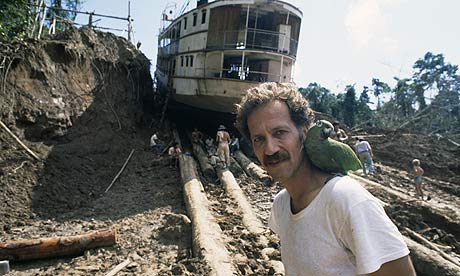
But it is definitely impressive.

That one criticism aside, this movie is a brilliant portrayal of what one man will do in order to obtain his dream. It is a overwhelming display of the enormity of the South American jungle and the human spirit. And yet another example of how German cinema is considered by some to be the best in the world.

My Rating: 8/10


Monday, February 23, 2015

The History of Film Part 1: Sallie Gardner at a Gallop

Movies and cinema are relatively new invention in contrast to the length of human existence on Earth. It is so new in fact, that there are some people still living that are older than motion pictures, or at the very least the wide distribution of it. Movies didn't begin to gain popularity until the early 1900s due to limited technology. So the chances that one of the oldest people living remembers a time when displaying 23.97 sequential pictures a second seemed like magic are pretty high.

With every invention, there is a beginning. Of course the very beginning of cinema is the photograph, there is another event in history that paved the way for all the films, directors and actors we all know and love today. And we have a horse to thank for it. A horse named Sallie Gardner.

"Aw, shucks!"

It all started with a question. While at a gallop, is there ever a moment where a horse as all four hooves off of the ground? While this may seem like a stupid question now, you have to remember the time period.

In 1878, Leland Stanford, and American tycoon and eventual Senator for California own a farm where he bred and trained race horses. While trying to improve the performance of his horses he became interested in his horses gait action. When the horses galloped, their movements were to quick to determine if there was ever a moment where the momentum kept the horse airborne. Even if just for a fraction of a second.

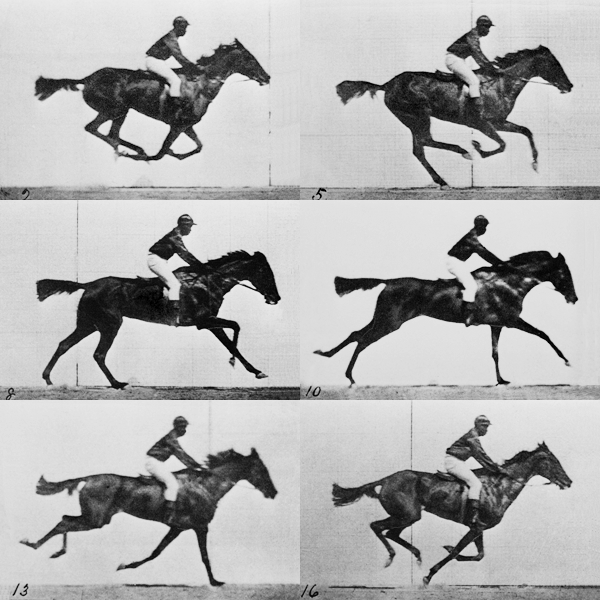
He financed a science project to determine the answer and he commissioned photographer Eadweard Muybridge (Because his birth name Edward Muggeridge just wasn't complicated enough). Together, they set up a series of 24 cameras, each with their own trip wire that would be triggered by the horses legs. The result of which were a series of pictures that gave them their answer.

Sallie Gardner at a Gallop
 The First Motion Picture,  June 15, 1878

After some time and examination, Muybridge first projected the images in quick succession during a presentation at the California School of Fine Arts in 1880, becoming the first ever exhibition of a motion picture ever. Could you just imagine how mind blowing that must have been to experience?

Let's just hope no one in the lecture was on 'shrooms, for their sake.

Muybridge eventually met with Thomas Edison (presumably in between schemes to screw people over) ,who later went on to develop the kinetoscope. The precursor to the modern movie camera. And thus, motion pictures were born.

Just think, this was a time when people barely knew what a photograph was. And the one who did know were still in awe of the new invention. The excitement one must have felt when seeing a moving picture for the first time, as an adult who could understand the scale of it's significance must have been overpowering. 

I only wish we still lived in a world where new inventions had more of an emotional impact. An impact past the "oh, that's pretty cool" feeling that is all I can seem to muster with each new invention. How amazing that would have been,